
2nd Grade - Gateway 3
Note on review tool versions
See the series overview page to confirm the review tool version used to create this report.
- Our current review tool version is 2.1. Learn more
- Reports conducted using earlier review tools (v1.0 and v1.5) contain valuable insights but may not fully align with our current instructional priorities. Read our guide to using earlier reports and review tools
Loading navigation...
Teacher and Student Supports
| Score | |
|---|---|
| Gateway 3 - Meets Expectations | 88% |
| Criterion 3.1: Teacher Supports | 11 / 13 |
| Criterion 3.2: Student Supports | 4 / 4 |
| Criterion 3.3: Intentional Design |
The IMSE’s OG+ materials meet expectations for Gateway 3 by providing coherent teacher supports, embedded student supports, and intentional design features that facilitate effective implementation of foundational skills instruction. Materials include point-of-use guidance, clear instructional routines, and adult-level explanations that support consistent delivery of phonemic awareness, phonics, word recognition, syllabication and word analysis, and fluency. Lessons follow a structured, research-based design with defined pacing and built-in review, though pacing is fixed and standards alignment is not explicitly identified. Student supports include small-group guidance, embedded differentiation, and visual and oral-language scaffolds, including supports for multilingual learners, while representation in texts is primarily surface-level with limited guidance for cultural responsiveness. Digital tools and visual design features support instruction through teacher-directed, customizable resources and consistent layouts, though student interactivity and ease of access across platforms are limited.
Criterion 3.1: Teacher Supports
Materials include embedded guidance to support effective implementation of foundational skills instruction and build teacher knowledge of grade-level expectations.
The IMSE’s OG+ materials meet expectations for Criterion 3.1 by providing embedded guidance that supports effective implementation of foundational skills instruction and strengthens teacher understanding of grade-level expectations. Materials include point-of-use annotations, explicit scripting, and clearly defined instructional routines that guide daily phonics, syllabication, and word analysis instruction and clarify how to use student and ancillary materials. Teacher-facing resources provide detailed adult-level explanations of foundational literacy concepts, including phonemic awareness, phonics, irregular word instruction, syllabication and word analysis, and fluency, grounded in established reading research. Instructional tools are consistently identified within lessons and aligned to specific purposes, and family-facing resources are written in accessible, jargon-free language to support foundational skills development at home.
Foundational skills lessons follow a consistent, research-based structure organized around multi-day concepts with defined objectives, structured routines, and coordinated whole-group and small-group instruction. Materials include built-in review and consolidation opportunities; however, pacing remains fixed across lessons and does not consistently account for instructional variability or reteaching needs. While the sequence is designed for completion within a school year, materials do not clearly explain how all grade-level foundational skills standards are mastered within that timeframe. Overall, the materials provide strong, coherent support for instructional delivery and teacher understanding, with some limitations in pacing flexibility and clarity around standards mastery.
Indicator 3a
Materials provide teacher guidance with useful annotations and suggestions for how to enact the student materials and ancillary materials, with specific attention to supporting students’ foundational literacy development.
The teacher guidance in IMSE's OG+ meets the expectations for Indicator 3a. Materials provide useful annotations and suggestions for how to enact student and ancillary materials, with specific attention to foundational literacy development. Program resources clearly outline instructional routines and lesson components that structure daily phonics, syllabication, and word analysis instruction. Lessons include explicit scripting, clearly defined teacher and student roles, and routine-specific guidance that supports consistent implementation. Instructional routines are grounded in explicit, systematic instruction and include reminders and variations to support responsive teaching.
Materials provide a well-defined, teacher resources for presenting content and instructional routines.
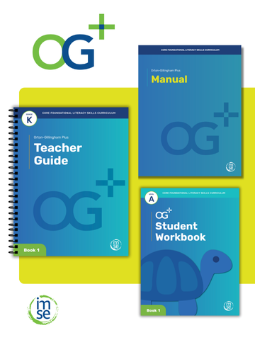
The OG+ Fidelity Companion provides a quick-reference guide for the instructional routines connected to the IMSE's OG+ core foundational skills curriculum. The Fidelity Companion corresponds to the teacher guides for Grade 2 through color-coded alignment of lesson components. Each instructional routine within the Fidelity Companion provides unbolded text that supports the teacher in understanding the purpose of each step of a routine and how to implement the routine effectively. The Fidelity Companion also includes bold text as a script for the teacher as an additional support.
Each instructional routine clearly demarcates what the Teacher Role is doing the routine and what the Student Role is in the routine. This support allows a teacher to both understand how to effectively present the routine and attune to the possible responses that are acceptable from students to continue the routine as designed.
The OG+ Manual provides guidance on the key components of an IMSE's OG+ lesson. For example, in the section “Part Five: Syllabication and Word Analysis Instruction”, the materials highlight key terminology, findings on the importance of teaching syllabication and word analysis, and more. The materials highlight the variations to the syllabication routine that are possible to implement based on students’ progress. Finally, the materials include important reminders for the routine. This guidance is representative of the support provided for understanding the components of an IMSE's OG+ lesson.
Materials include annotations and suggestions to support implementation, presented in the context of specific learning objectives.
In Concept 73, Day 3, Syllable Division/Word Analysis, the materials provide guidance to teachers so that they support the specific learning objective of students using syllabication strategies to decode multisyllabic words with au and aw. The materials note that since au and aw spell a vowel sound, “they will be underlined and labeled with a ‘V’.” This note supports the learning objective for the concept.
In Concept 82, Day 1, Phonics: Teaching a New Concept, the materials provide guidance to the teacher so that they can support the specific learning objective of students demonstrating an understanding of silent letters. The materials provide an additional support note that the teacher can introduce silent letters over the course of several days during the week and provide a list that can aid this approach including:
/g/ spelled as -gh and represented in the words afghan, ghastly, and ghost;
/n/ spelled as -gn and represented in the words gnarl, gnat, and gnaw;
/n/ spelled as -kn and represented in the words knack, knee, and knuckle;
/m/ spelled as -mb and represented in the words bomb, crumb, and thumb;
/s/ spelled as -sc and represented in the words scene, science, and scissors;
/r/ spelled as -wr and represented in the words wrap, wrinkle, and written; and
/əl/ spelled as -tle and represented in the words castle, whistle, and nestle.
This guidance supports the learning objective for the concept.
Indicator 3b
Materials contain full, adult-level explanations and examples of the foundational skills concepts included in the program so teachers can improve their own knowledge of the subject.
The adult-level explanations in IMSE's OG+ meet the expectations for Indicator 3b.. Materials contain full, detailed explanations and examples of foundational skills concepts so teachers can strengthen their knowledge of the subject as needed. Teacher-facing resources describe the research base of the program and outline each foundational skills component taught at the grade level, including phonemic awareness, phonics, irregular word instruction, syllabication and word analysis, and fluency. The materials explain how these skills develop and connect to established reading research.
Complete, detailed adult-level explanations are provided for each foundational skill taught at the grade level.
According to the OG Plus Manual, the materials include a comprehensive Research and Theory Foundations section that provides adult-level explanations of the research base underlying the program. This section begins with an explanation of the science of reading, clarifying that the science of reading is not a specific program or approach, but a body of research derived from multiple disciplines, including cognitive psychology, communication sciences, developmental psychology, education, implementation science, linguistics, neuroscience, and school psychology.
The Simple View of Reading as a research-supported framework for understanding reading comprehension. The materials explain that reading comprehension is the product of word recognition and language comprehension and describe how these components interact to support skilled reading.
A detailed explanation of Scarborough’s Reading Rope, describing how multiple strands of language comprehension and word recognition are woven together over time to result in skilled reading. The materials explain the language comprehension strands, including background knowledge, vocabulary, language structures, verbal reasoning, and literacy knowledge, as well as the word recognition strands, including phonological awareness, decoding, and sight recognition.
Ehri’s four phases of word reading development, including the pre-alphabetic, partial alphabetic, full alphabetic, and consolidated alphabetic phases. The materials describe how students progress through these phases as their word reading skills develop.
A section on orthography, orthographic memory, and orthographic mapping that explains how phonemic awareness, letter–sound knowledge, and pronunciation work together to support the development of orthographic memory and sight word vocabulary.
The materials reference key findings from the National Reading Panel and explain how those findings inform instructional design across foundational skills instruction.
The materials include dedicated sections for each component of foundational skills instruction taught in the IMSE's OG+ program, including phonemic awareness , irregular word instruction, syllabication and word analysis, and fluency. Each section provides background knowledge and supporting research to explain why the component is critical to reading development.
Detailed examples of the grade-level foundational skills concepts are provided for the teacher.
According to the OG Plus Manual, the phonemic awareness section includes detailed examples and instructional implications related to phonological awareness and phonics, including explanations of the 44 sounds of the English language. The materials describe phoneme blending and segmenting and include key findings that inform instructional practice in Kindergarten. Additional sections include, but are not limited to the following:
The Phonics instruction section includes examples that explain how phonics concepts are applied through instruction, including cross-linguistic connections, sound scenes, spelling as application through words and sentences, and instruction that progresses toward multisyllabic words.
The Irregular Word instruction section provides detailed explanations and examples for the teacher related to irregular words, high-frequency words, sight words, and commonly referenced word lists such as Dolch words and Fry words, supporting teacher understanding of how and why these words are taught.
The Syllabication and Word Analysis section includes detailed explanations and examples of multisyllabic word instruction, including the six syllable types—closed, open, Magic e, vowel team, Bossy R, and consonant-le—as well as the four syllable division patterns VC/CV, V/CV, VC/V, and V/V. The materials also include examples related to morphology instruction, including affixes and bases.
The Fluency section provides detailed examples and instructional explanations related to fluency development, including the role of modeling and practice, the use of intonation and prosody, reader’s theater, and additional strategies for supporting fluency. The materials also explain levels of reading ability, including independent, instructional, and frustration levels, and include considerations for English learners related to fluency development.
Indicator 3c
Foundational skills lessons are well-designed and take into account effective lesson structure and pacing. Content can reasonably be completed within a regular school year, and the pacing allows for maximum student understanding.
The lesson design and pacing in IMSE's OG+ partially meet the expectations for Indicator 3c. Materials use a consistent, research-based lesson structure organized around five-day concepts that systematically introduce, practice, and apply foundational skills through coordinated whole-group and small-group instruction. Daily lesson plans include clear objectives, structured routines aligned to early literacy components, and defined time allocations that support consistent implementation. However, pacing remains fixed across lessons regardless of instructional complexity, and flexible time for reteaching is referenced rather than explicitly embedded within daily plans. Although the Grade 2 sequence is designed for completion within a traditional school year, materials do not clearly explain how all grade-level foundational skills standards are mastered within one year.
Lesson plans utilize effective, research-based lesson plan design for early literacy instruction.
According to the Teacher Guide, daily lesson plans are organized around concepts. Each concept has five days of instruction devoted to it. Within each concept, there are clear learning objectives, ideas for incorporating objects and keywords that illustrate the concept, and literature connections that go beyond the connected text provided in the curriculum. Each day of instruction has materials listed, additional support for the teacher and students, and suggested language for effective implementation of routines. Over the course of the five days of instruction for each concept, lessons will address the key components of early literacy instruction through various routines. Examples of those routines in the Grade 2 sequence are listed below next to the corresponding early literacy skill they are meant to support.
Phonological Awareness: Word Chaining (Phoneme Manipulation)
Phonics: Syllable Division/Word Analysis
High Frequency, Irregular Word Recognition: Irregular Words (Red Words)
Writing: Spelling (Written Application of a New Concept)
Fluency, Vocabulary, Comprehension: IMSE's OG+ Decodable Readers
The effective lesson design structure includes both whole group and small group instruction.
According to the Teacher Guide, lessons include both whole group and small group instruction. Lessons can be implemented within various time scales (30 minutes to 90 minutes or more) segments depending on if the curriculum is used as a core foundational literacy skills curriculum or a supplemental curriculum. When used as a core foundational literacy skills curriculum, whole-group instruction lasts between 30 and 40 minutes. Small group activities are used for practicing and reinforcing skills that have been introduced in whole-group instruction, such as practicing lowercase letter formation, engaging with the Rapid Word Chart for decodable readers, as well as other extension activities.
The pacing of each component of daily lesson plans are sometimes clear and appropriate.
In Concept 58, Day 3, each lesson component has clear timings (listed below).
Word Chaining (Phoneme Manipulation): 3 minutes
Cumulative Review (Three-Part Drill): 8 minutes
Phonics (Spelling): 6 minutes
Irregular Words (Red Words): 3 minutes
Syllable Division/Word Analysis: 5 minutes
Reading: 15 minutes
Total time: 40 minutes for whole-group instruction
In Concept 81, Day 2, each lesson component has clear timings (listed below).
Review the New Concept: marked as optional with no timing suggestion
Phonics (Spelling): 6 minutes
Irregular Words (Red Words): 10 minutes
Reading: 15 minutes
Total time: 31 minutes for whole-group instruction
Although daily lesson components include clearly defined timed segments that support consistent implementation, pacing remains fixed across lessons regardless of instructional complexity. While guidance is provided for reteaching based on student performance, materials do not consistently build in flexible time within daily plans to accommodate concepts that may require extended instruction. This structure supports systematic delivery but may limit responsiveness to student need within individual lessons.
The suggested amount of time and expectations for maximum student understanding of all foundational skills content can reasonably be completed in one school year and should not require modification.
According to the OG+ Manual, students are introduced to 26 concepts throughout the Grade 2 sequence. Each concept has five days of instruction devoted to that concept alone. The materials state that there is "intentional space to spend time reviewing concepts, teaching complex concepts, adjusting for instructional calendar days, or accommodating unique schedules based on assessment data.” The instructional schedule reflects this intention, as the entire sequence, with time for assessment and review, is designed to be completed in 32 weeks.
For those materials on the borderline (e.g., approximately 130 days on the low end or 200 days on the high end), evidence does not explain how students would be able to master ALL the grade-level foundational skills standards within one school year.
Not observed
Indicator 3d
Materials contain strategies for informing all stakeholders, including students, parents, or caregivers about the foundational skills program and suggestions for how they can help support student progress and achievement.
Materials contain jargon-free resources and processes to inform stakeholders about the foundational skills taught at school. Family-facing letters in English and Spanish explain the instructional approach in accessible language and direct caregivers to additional online supports. Materials also provide stakeholders with strategies and activities to reinforce foundational skills at home. Caregiver resources describe the essential components of reading in non-technical language and offer grade-band guidance for supporting foundational literacy development. Together, these materials support stakeholders in understanding and reinforcing Grade 2 foundational skills instruction.
Materials contain jargon-free resources and processes to inform all stakeholders about foundational skills taught at school.
According to the OG Plus Manual, the materials include a Dear Parent letter provided in both English and Spanish that explains the foundational skills program and instructional approach in accessible, family-friendly language. The letter describes why the program is being implemented, outlines the professional learning completed by the teacher, and explains how instruction differs from traditional spelling workbook approaches. The explanation focuses on helping families understand that instruction is multisensory, systematic, structured, sequential, cumulative, and success-oriented, without relying on technical or instructional jargon.
The Dear Parent letter also explains how phonetic and irregular words are taught, how concepts are reviewed and applied over time, and how assessments are used to monitor mastery. The letter is written to help caregivers understand how students learn to read and spell within the program and how skills are intended to transfer to long-term reading and writing success.
The materials also include a second family-facing letter titled Dear Partners in Education, which directs families to additional support resources through a QR code. The QR code links to the IMSE's OG+ website page Resources for Parents, providing an accessible entry point for families to learn more about the instructional approach and foundational skills development.
Materials provide stakeholders with strategies and activities for practicing print concepts, phonemic awareness, phonics, word recognition, and fluency that will support students in progress toward and achievement of grade-level foundational skills standards.
According to the Digital IMSE's OG+ platform, the Resources for Parents webpage provides caregivers with explanations of the five essential components of reading instruction, including phonological awareness, phonics, fluency, vocabulary, and comprehension. Each component is described in clear, non-technical language to support caregiver understanding of how reading skills develop.
The parent resources include guidance on how families can support literacy development at home through age- and grade-level appropriate activities. The materials organize suggested activities by developmental bands, including Pre-Kindergarten, Kindergarten–Grade 2, and Grade 3 and beyond, allowing caregivers to select activities aligned to their child’s current stage of reading development.
The parent resources include guidance for supporting struggling readers, including recommended steps for addressing reading challenges at home and in coordination with school instruction. The materials encourage caregivers to use structured practice and to access additional supports when needed.
The materials provide links to free parent resources, instructional videos, and activity materials that support practice with foundational skills at home. These resources include opportunities for practicing phonemic awareness, phonics, word recognition, and fluency through repeated exposure and application.
Lastly, the materials also connect families to external support options, including information about IMSE's OG+-trained tutors and partnerships with organizations such as Learning Ally, offering additional pathways for families to support student reading development beyond the classroom.
Indicator 3e
Note: Content for this indicator is fully addressed in 3b, which covers adult-level explanations and examples of foundational skills concepts. No separate scoring is required.
Indicator 3f
Materials embed consistent teacher guidance for the use of instructional tools and supports necessary for foundational skills instruction.
Rationale: The teacher guidance for using instructional tools in IMSE's OG+ meets the expectations for Indicator 3f. Materials consistently identify the physical and digital tools used across foundational skills lessons and reference them directly within routines so the teacher knows what to use and when. Tools are aligned to specific instructional purposes across phonological awareness, phonics, syllable division, encoding, and fluency. Teacher-facing resources provide clear guidance on how and when to use these tools within daily instruction.
Materials consistently identify tools (e.g., Elkonin boxes, letter tiles, sound walls, mirrors) within lesson routines and instructional steps.
The Teacher Guide provides an overview of the materials that can be found through IMSE's OG+ LAB (e.g. customizable student dictation pages, student practice pages for syllable division).
Tools required are consistently identified within the context of lesson routines and instructional steps.
In Concept 61, Day 1, Phonics: Teaching a New Concept, materials necessary for students and the teacher are clearly marked in the margins of the resource. The materials also prompt the teacher in several places to use particular tools to support the introduction of the concept of the Bossy R in ir /er/ as in bird (e.g. “Show the new concept card (Card #54)”; “Remember our poster of triplets Bertha, Shirley, and Curt to help us remember the three main spellings of /er/”).
In Concept 65, Day 3, Cumulative Review: Three-Part Drill, materials necessary for students and the teacher are clearly marked in the margins of the resource. For the blending portion of the drill, the teacher is to place the yellow vowel cards in the Phoneme/Grapheme Card Pack in the middle of the blending board.
Materials provide teacher-facing guidance on how and when to use these tools to support instruction in phonological awareness, phonics, fluency, and encoding.
In Concept 58, Day 3, Syllable Division/Word Analysis, the materials guide the teacher to use Syllable Division Posters to support students’ practice with syllable division which supports fluency. The teacher is guided to tear paper to separate the syllables in a word because “tearing paper at syllable breaks helps make the abstract process of Syllable Division more concrete for students who are beginning to learn to read multisyllabic words.” The materials also guide the teacher to use the Syllable Division Posters at key points in the instructional routine (e.g. “Look at my poster and look at the word. What pattern do you see? Pattern 1? Pattern 2? Or Pattern 3?”).
In Concept 77, Day 3, Reading, the materials guide the teacher to use fluency pyramids available in IMSE's OG+ LAB “for students who need additional scaffolds to aid in fluent reading.” The fluency period for Concept 77 highlights ph and gh as ways to make the /f/ sound. The Fluency Pyramid sheet provides the instructions to “start at the top of the sentence pyramid and read each line until you complete the sentence. Draw a check mark in the box once you complete each sentence.”
Indicator 3g
Materials include publisher-produced alignment documentation of the standards addressed by specific questions, tasks, and assessments and assessment materials clearly denote which standards are being emphasized.
Materials do not include denotations of the foundational skills standards being assessed in either formative or summative assessments. Alignment documentation is not provided for assessment tasks, questions, or items. Materials also do not contain foundational skills standards correlated to specific lessons.
Materials do not include denotations of the foundational skills standards being assessed in the formative assessments.
Materials do not include denotations of the foundational skills standards in formative assessments.
Materials do not include denotations of foundational skills standards being assessed in the summative assessments.
Materials do not include denotations of foundational skills standards in summative assessments.
Alignment documentation is not provided for all tasks, questions, and assessment items.
Materials do not provide alignment documentation for tasks, questions, or assessment items.
Alignment documentation does not contain specific foundational skills standards correlated to specific lessons.
Materials do not contain foundational skills standards correlated to specific lessons.
Indicator 3h
This is not an assessed indicator in ELA.
Criterion 3.2: Student Supports
Materials are designed for each child’s regular and active participation in grade-level foundational skills content and include embedded supports for student access, engagement, and differentiation.
The IMSE’s OG+ materials meet expectations for Criterion 3.2 by supporting students’ regular and active participation in grade-level foundational skills content and including embedded supports for access, engagement, and differentiation. Materials include guidance for organizing small-group instruction based on assessment data and provide embedded differentiation within core routines, including adjusted word lists, repeated practice, and scaffolded instruction. These supports allow students to continue engaging with grade-level skills while receiving targeted instruction, enabling multiple pathways toward mastery.
Materials include visual and informational representation of varied cultural, racial, gender, and ability backgrounds in decodable and connected texts. Representation is primarily surface-level, as cultural and community contexts are not developed beyond these depictions. Supports for multilingual learners include visual scaffolds, oral-language routines, and cross-linguistic connections that link phonics and word analysis instruction to meaning, with many supports designed for Spanish-speaking students. Guidance for incorporating students’ cultural, social, and community backgrounds into foundational skills instruction remains limited.
Indicator 3j
Materials provide strategies and supports for students in special populations to work with grade-level content and to meet or exceed grade-level standards.
The strategies and supports for students in special populations in IMSE’s OG+ meet the expectations for Indicator 3j. Materials provide guidance for organizing small group instruction, including flexible grouping based on assessment data and targeted reteaching aligned to specific skill needs. Differentiation is embedded within instructional routines, with supports such as adjusted word lists, repeated practice, and scaffolded instruction to reinforce learning. Materials also include guidance for adapting instruction by breaking down complex skills and pacing content over multiple days, supporting students in accessing grade-level foundational skills content.
Materials provide opportunities for small group reteaching.
The Grade 2 Teacher Guide provides suggestions for how to incorporate small group activities. The materials state that small groups are ideal for:
Reteaching or remediation for students who need additional scaffolds
Providing more intensive instruction for students; and
Implementing IMSE's OG+’s routines at the beginning of the year, among other activities.
IMSE's OG+ LAB provides grouping suggestions based on assessment results. Students are grouped into four groups based on the results of each assessment, meaning that students can be differentially grouped based on the specific skill that needs reteaching (e.g. spelling and encoding, reading and decoding, phonemic awareness, and so on). The groups are separated as follows:
Group 1 (At Benchmark, ≥ 80%)
Group 2 (Support Needed, 70-79%)
Group 3 (Targeted Support Needed, 51-69%)
Group 4 (Intensive Support Needed, ≤ 50%)
According to the OG+ Fidelity Companion, differentiation guidance is embedded within instructional routines for small group and intervention instruction.
For example, in Irregular Words: Red Words, materials direct the teacher to “continue to work on red words based on individual assessment results” and to “consider red word extension activities and partner activities for practice in spelling and reading red words.” Materials note that “differentiated red word lists may be appropriate for students who are working on earlier phonetic concepts in the IMSE's OG+ sequence” and suggest using “spell & read red words and read-only red words that align with earlier phonetic concepts.”
Materials provide guidance to the teacher for scaffolding and adapting lessons and activities to support students who read, write, speak or listen below grade level in accessing grade-level foundational skills standards.
In Concept 58, Day 1, Phonics: Teaching a New Concept, the materials provide guidance for additional support that a teacher could provide students. The focus of this concept is on three-consonant blends and blends with digraphs. If students have difficulty with this concept, the materials suggest breaking up the blends “to focus on explicitly teaching and applying knowledge of only a few at a time.” The materials give an example of how to break up the blends in the following manner:
Day 1: scr, shr, and spl
Day 2: spr and squ
Day 3: str and the
Day 4 & 5: Review and assess
In Concept 75, Day 1, Phonics: Teaching a New Concept, the materials provide guidance for additional support that a teacher could provide students. The focus of the unit is on other uses for silent e. The materials suggest that the teacher may want to introduce the different uses of the silent e concept over the course of several days. The materials give an example of how to break up these uses, separating onto different days the following:
/s/ spelled -se
/z/ spelled -se
/v/ spelled -ve
/j/ spelled -dge or -je
/s/ spelled -ce
Indicator 3k
This indicator is not assessed in reviews of K-2 ELA foundational skills supplements.
Indicator 3l
This indicator is not assessed in reviews of K-2 ELA foundational skills supplements.
Indicator 3m
This indicator is not assessed in reviews of K-2 ELA foundational skills supplements.
Indicator 3n
This indicator is not assessed in reviews of K-2 ELA foundational skills supplements.
Indicator 3o
Materials provide a range of representation of people and include detailed instructions and support for educators to effectively incorporate and draw upon students’ different cultural, social, and community backgrounds to enrich learning experiences.
The IMSE's OG+ materials include decodable and connected texts that provide representation of people from varied cultural, racial, gender, and ability backgrounds. Representation is primarily visual, with limited development of characters’ cultural identities beyond illustrations and brief references. Materials include general guidance acknowledging the role of students’ cultural, social, and community backgrounds in literacy development; however, they do not provide explicit strategies or routines for incorporating these backgrounds into foundational skills instruction.
Decodable and connected texts provide a range of representation of people, ensuring a broad range of cultural, racial, gender, and ability backgrounds are accurately and authentically represented.
Materials include a range of decodable and connected texts that reflect representation of people across racial, gender, cultural, and ability backgrounds. For example, In Book #51 Concept 61, Twins: Take Two (NonFiction), Book 56 Concept 63, Let’s Make and Enjoy (Nonfiction), the cover and illustrations depict characters with varied skin tones. In Book #60 Concept 67, Saving the Planet (NonFiction), illustrations include an adult using a wheelchair and in Book #71 Concept 78, How Does Sound Work? (Nonfiction) Includes a student with a hearing aid, representing various physical abilities.
For Grade 2, representation is primarily visual; characters’ cultural contexts, traditions, or identities are not developed beyond illustration.
Materials provide detailed instructions and support for teachers on incorporating and drawing upon students’ different cultural, social, and community backgrounds to enrich learning experiences.
According to the OG Plus Manual, Student Factors that Contribute to Literacy Development, Environmental, Cultural and Social Factors section, states that cultural values and practices significantly impact how families engage with literacy and notes that some communities may prioritize life skills or traditional practices over formal education. The guidance emphasizes recognizing and respecting these differences and highlights the importance of culturally responsive teaching that builds on students’ strengths and experiences.
Indicator 3p
This is not an assessed indicator in ELA.
Indicator 3q
This is not an assessed indicator in ELA.
Indicator 3.MLL
Materials provide embedded supports to help multilingual learners (MLLs) develop foundational reading and writing skills. Instruction draws on oral and home language resources and reflects the interdependence of language and literacy development.
The IMSE's OG+ materials provide language and visual scaffolds to support multilingual learners, including guidance for building on students’ home language and using cognates and structured supports to access grade-level foundational skills instruction. Materials include modeling and cross-linguistic comparisons of phonemes, graphemes, and sound-symbol correspondences, with supports primarily designed for Spanish-speaking students, reflecting the most commonly represented population of multilingual learners. Oral language development is embedded through routines that support vocabulary development and comprehension as a bridge to literacy. Materials provide guidance for minimizing the use of nonsense words with multilingual learners while acknowledging their use in instruction and assessment. Foundational skills instruction is connected to meaning through integrated language supports that emphasize comprehension alongside decoding.
Materials include embedded language and content, and visual scaffolds (e.g., pictures, graphic organizers, anchor charts) that help MLL students access grade-level foundational skills instruction.
According to the OG+ Manual, "literacy instruction for [English Learners] should be built on the literacy skills that are already in place in their first language.” This idea is reiterated within the Teacher Guide, Additional Support for English Learners, in the support for cross-linguistic connections that “bridge a student’s first language and the language of school.” There are several examples of such support within the materials.
In Concept 62, Day 4, Reading, the materials include a table that describes the key vocabulary words, Spanish cognates, and words recommended for explicit teaching for each decodable reader option. This table also identifies which words have multiple meanings and should be explicitly taught within the context of the reader. Tables like this are representative throughout the curriculum within the Reading activity.
In Concept 66, Day 1, Teaching a New Phonics Concept, the materials direct the teacher to use a poster that reinforces the double rule (e.g. doubling the final consonant in a word with a short vowel sound when adding a suffix that begins with a vowel). This resource can support English Learners access the foundational skills instruction for this concept.
Materials include modeling and cross-linguistic comparisons of phonemes, graphemes, and sound-symbol correspondences where English and home language patterns differ.
In the Teacher Guide, Additional Support for English Learners, the materials provide a Spanish/English Phoneme Transfer Chart which offers a “bird’s-eye view of IMSE's OG+’s Cross-Linguistic Connections and the degrees of sound transferability between the two languages.” The table provides an example of the phonemes taught within the Kindergarten sequence and if they are fully transferable, partially transferable, or not transferable between English and Spanish. For example, the schwa concept (Concept 59 is not transferable between English and Spanish, but the diphthong /oi/ (Concept 63) is fully transferable between English and Spanish.
In Concept 59, Day 1, Cross-Linguistic Connections, the materials provide the teacher with guidance on how to instruct Spanish-speaking students in the schwa sound. The materials guide the teacher to introduce and emphasize the mouth position needed to produce the sound, as “these sounds may be new to your Spanish-speaking students.”
Additional examples of Cognate Charts and Cross-Linguistic Connections can be found for each relevant concept in the English Learner Library on IMSE's OG+ LAB. Also, materials include cross-linguistic supports that are primarily designed for Spanish-speaking students, reflecting the program’s emphasis on the most commonly represented population of multilingual learners. Materials note that 75% of English learners are Spanish-speaking.
Materials include tasks or routines that develop oral language as a bridge to literacy (e.g., structured speaking, listening, and vocabulary development).
In the Teacher Guide, General EL [English Language] Considerations for IMSE's OG+ Lesson Components, the materials suggest that English Learners “receive direct instruction for new vocabulary so word-level comprehension can be acquired.” Through additional practice with the materials, comprehension, the ultimate goal of skilled reading, can be achieved. The Teacher Guide provides similar suggestions for EL instruction in all of the components of an IMSE's OG+ OG+ lesson.
Materials avoid the use of nonsense words in instruction or assessment for MLLs and may acknowledge that unfamiliar real words can function as nonsense words for these students.
Throughout the IMSE's OG+ curriculum, nonsense words are used in instruction and assessment. However, the materials do acknowledge the need to note when words are nonsense words and suggest avoiding these words in particular situations.
For example, in the Level 2 Initial Benchmark, Spell Words and Sentences assessment, the teacher is instructed to provide the following guidance to students for spelling phonetic nonsense words: “I will say a word that is not a real word. I want you to spell the word based on what you know about the sounds in the word and the letters you know that spell those sounds.”
Materials support meaning-making through early literacy instruction, rather than emphasizing isolated decoding alone.
In the OG+ Manual, the materials emphasize that “learning to decode words is only one piece of the puzzle.” In addition to decoding, the materials emphasize that English Learners “may need support to acquire vocabulary, figurative language, idioms, or complex sentence structures. For this reason, the integration of language development with reading instruction is highly recommended for ELs at all levels of language proficiency.”
For example, in Concept 62, Day 4, Reading, the materials emphasize that for the decodable reader titled What’s for Dinner, the teacher should explicitly teach the word pleading, and may so explicitly engage with the other vocabulary words of blurt and frankfurter. Multiple readings of the text throughout each concept of instruction allows the teacher the time and opportunity to implement such scaffolds.
Criterion 3.3: Intentional Design
Materials include a visual design that is engaging and supportively organized, and integrate digital technology, when applicable, with guidance for teachers.
The IMSE’s OG+ materials include digital technology and visual design features that support foundational skills instruction, with accompanying guidance for teachers. Digital resources available through the IMSE Lab platform provide lesson-aligned slides, visual models, decodable texts, and structured practice materials that reinforce phonics, word analysis, fluency, and vocabulary. These tools are used within structured routines aligned to the program’s scope and sequence and can be customized by the teacher to match instructional goals or student needs. Student engagement with digital materials occurs primarily through teacher-directed use rather than direct interaction.
The visual design of both print and digital materials supports learning without distraction. Consistent layouts, routines, and organizational features help students and teachers navigate lessons and reinforce instructional structures. Materials include guidance for integrating technology that explains the purpose of digital tools and aligns their use to instruction; however, access to these resources is distributed across multiple sections, which may require additional navigation. Overall, the integration of visual design and digital resources supports instructional clarity and engagement, with some limitations in student interactivity and ease of access.
Indicator 3r
Materials integrate technology such as interactive tools, virtual manipulatives/objects, and/or dynamic software in ways that engage students in the grade-level/series standards, when applicable.
The IMSE's OG+ materials include digital technology that supports foundational skills instruction through teacher-directed tools available in the IMSE's OG+ Lab platform. Digital resources such as slides, visual models, decodable texts, and structured practice materials align to lesson routines and reinforce phonics, word analysis, fluency, and vocabulary. These tools support student engagement through teacher-led display rather than direct student interaction. Digital materials offer opportunities for customization, allowing the teacher to adjust content, formats, and practice materials to align with instructional goals and student needs. However, the platform does not include student-interactive tools such as simulations or independent modeling features.
Digital technology and interactive tools, such as data collection tools, simulations, and/or modeling tools are available to students.
Digital technology and interactive tools are available within the IMSE's OG+ Lab platform for teacher use in delivering Grade 2 instruction. These tools are designed for display, download, and customization by the teacher and include:
Three-Part Drill Icon, with core and intervention slides, customizable layouts, selectable graphemes aligned to specific concepts, and font options.
New Concept Icon, with animated visuals of new spelling rules and aligned Google Slides.
Dictation Icon, with premade dictation PDFs and customizable materials filtered by concept, orientation, cue size, and inclusion of words, Red Words, and sentences.
Red Words Icon, including core and intervention slides, premade Red Words, flashcards, color and number cards, and customizable Red Word lists.
Fluency Icon, with downloadable word cards, student pages, Concept Pyramid cards, and customizable rapid word charts aligned to selected concepts.
Decodable Text Icon, including digital views of fiction and nonfiction decodable texts with accompanying student pages and links to additional digital formats.
Vocabulary Icon, with digital Google Slides aligned to vocabulary instruction.
Syllable Division Icon, which includes:
Printable student syllable division PDF pages.
Customizable materials allowing the teacher to select grid layout or word strip format.
Options to select words for syllable division practice.
Save, download, and print functionality.
Digital tools are available for teacher display and customization; however, students do not directly interact with digital simulations or modeling tools.
Digital tools support student engagement in foundational skills.
According to the IMSE's OG+ Lab, digital tools support student engagement in foundational skills through teacher-led display of animated spelling rule modeling, syllable division practice materials, digital decodable texts, fluency tools, vocabulary slides, and structured drill routines. The resources mirror the lesson procedures in the Teacher Guide and reinforce multisyllabic word reading, syllable division, dictation, fluency, and Red Word instruction. Students engage with the materials through teacher-directed use of digital slides and printable resources; the platform does not include student-interactive digital activities.
Digital materials can be customized for local use (i.e., student and/or community interests).
Digital materials can be customized by the teacher for local use within the IMSE's OG+ Lab platform. The teacher can:
Select concepts and graphemes aligned to instruction.
Adjust layout formats and font styles.
Customize dictation materials and Red Word lists.
Build rapid word charts aligned to selected concepts.
Create syllable division practice materials by selecting layout type and words.
Indicator 3s
This indicator is not assessed in reviews of K-2 ELA foundational skills supplements.
Indicator 3t
The visual design (whether in print or digital) is not distracting or chaotic, but supports students in engaging thoughtfully with the subject.
The IMSE's OG+ materials include images, graphics, and models that support student learning and engagement without being visually distracting. Visuals consistently reinforce foundational skills concepts, routines, and instructional cues, and clearly communicate information to support student understanding. Teacher and student materials maintain a consistent layout and structure across lessons, using repeated routines, formats, and design features that align across print and digital resources. Organizational features are clear and accurate, with consistent labeling and references that support ease of navigation and implementation.
Images, graphics, and models support student learning and engagement without being visually distracting. Images, graphics, and models clearly communicate information or support student understanding of topics, texts, or concepts.
Student-facing images, graphics, and models in the materials support student learning without being visually distracting. Examples include, but are not limited to:
Use of posters and other resources available digitally and referenced in lesson text
In Concept 64, Day 3, Syllable Division/Word Analysis, the materials suggest that the teacher shows students the Vowel Team Poster to support the identification and analysis of words with the diphthongs ou and ow. Within the syllable division routine, these diphthongs will be labeled “VT” to stand for Vowel Teams. This poster can be found within the digital Originals.
In Concept 70, Day 1, Phonics: Teaching a New Concept, the materials suggest using the Kind Old Words Poster as a visual to emphasize that the vowel i usually says /ī/ when it comes before -nd or -ld, and the vowel o usually says /ō/ when it comes before -ld, -lt, or -st. This poster can be found within the digital Originals.
Decodable readers present engaging images that support student understanding. For example, the nonfiction decodable reader for Concept 66, titled The Circus, has clear photographs of a range of individuals to represent the attractions that can be found at a circus. These visuals support the vocabulary presented in the book, such as acrobat and tightrope. Decodable readers are provided in both color and grayscale formats, allowing the teacher to determine how to present these readers to their students.
Teacher and student materials are consistent in layout and structure across lessons/modules/units.
The design and layout of teacher and student materials remain consistent across the Grade 2 program. The identification of routines through consistent color application throughout materials (e.g. Teacher Guide, Fidelity Companion) and formats (e.g. physical materials and digital resources). Lessons follow a repeated sequence, depending on the day within each concept. The scope of each lesson is as follows:
Day 1
Phonemic Awareness: Blending and Segmenting
Cumulative Review: Three-Part Drill and Vowel Intensive Drill
Phonics: Teaching a New Concept
Spelling
Irregular Words
Day 2
Review Spelling
Irregular Words
Reading
Day 3
Word Chaining (Phoneme Manipulation)
Cumulative Review: Three-Part Drill and Vowel Intensive Drill
Review Spelling
Syllable Division/Word Analysis
Irregular Words
Reading
Day 4
Word Chaining (Phoneme Manipulation)
Irregular Words
Review Spelling
Syllable Division/Word Analysis
Reading
Day 5
Cumulative Review: Three-Part Drill and Vowel Intensive Drill
Irregular Words
Spelling: Assessment
Syllable Division/Word Analysis
Reading
Organizational features (Table of Contents, glossary, index, internal references, table headers, captions, etc.) in the materials are clear, accurate, and error-free.
Organizational features in the materials are clear and accurate. References between resources (e.g. Teacher Manual, Fidelity Companion, and digital Originals) are consistent and accurate, making cross-referencing for instructional steps and gathering resources for students efficient. Resources, such as assessment materials, that have both student-facing and teacher-facing components are clearly labeled and designed for their intended user.
Indicator 3u
Materials provide teacher guidance for the use of embedded technology to support and enhance student learning, when applicable.
The IMSE's OG+ materials provide teacher guidance for the use of embedded technology to support foundational skills instruction. Guidance explains the instructional purpose of digital tools and aligns them to the scope and sequence, supporting integration within lesson routines. Guidance focuses on instructional explanation rather than detailed implementation of technology-enhanced student interaction. Access to digital resources is distributed across multiple sections which may require additional navigation to locate and use materials efficiently.
Teacher guidance is provided for the use of embedded technology to support and enhance student learning, when applicable.
Teacher guidance is provided for the use of embedded technology within the IMSE's OG+ Lab platform. Each digital icon includes an explanatory description outlining the instructional purpose and how the digital materials support foundational skills instruction. Examples include, but are not limited to:
Fluency Icon, which explains fluency as the bridge between foundational skills and comprehension and emphasizes practice with words, phrases, sentences, and passages containing explicitly taught concepts to build accuracy, automaticity, and prosody.
Syllable Division Icon, which explains the purpose of syllabication as a decoding strategy for multisyllabic words, outlines the sequence of syllable types and patterns taught, and describes how syllable recognition supports fluent reading and vocabulary development.
Decodable Text Icon, which explains that decodable readers provide phonetically controlled practice aligned to explicitly taught skills and serve as a bridge between phonics instruction and independent reading. Guidance directs the teacher to access printable or digital versions for instructional use.
Teacher guidance explains the instructional purpose of digital tools and aligns them to the scope and sequence; however, guidance focuses on instructional explanation rather than detailed implementation of technology-enhanced student interaction. Guidance for accessing and using digital resources is distributed across multiple sections such as, My Materials, Digital Resources, and IMSE's OG+ Lab, which may require additional navigation to locate and use materials efficiently.