
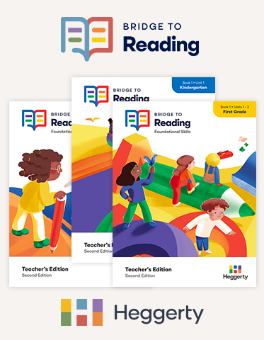
Bridge to Reading, Second Edition
Note on review tool versions
See the top of the page to confirm the review tool version used to create this report.
- Our current review tool version is 2.0. Learn more
- Reports conducted using earlier review tools (v1.0 and v1.5) contain valuable insights but may not fully align with our current instructional priorities. Read our guide to using earlier reports and review tools
Loading navigation...
Report Overview
Ratings Snapshot
| Gateway | K | 1 | 2 |
|---|---|---|---|
| Gateway 1 | |||
| Gateway 3 |
ELA K-2 Overview
The Bridge to Reading materials partially meet expectations for Grades K–2 by providing explicit, systematic instruction that develops foundational reading skills through a coherent progression and consistent instructional routines across grade levels.
In Kindergarten, Gateway 1 materials establish a foundation in alphabet knowledge, phonemic awareness, early phonics, and word recognition. Instruction includes explicit teacher modeling, guided and independent practice, and cumulative review through consistent routines that support letter–sound knowledge, decoding, encoding, spelling, and high-frequency word recognition. Assessments occur throughout the year to monitor progress across foundational skills. While early decoding and encoding are well supported, syllabication and morpheme analysis are more limited. Materials do not explicitly teach syllable types or syllable-division strategies, and explicit morpheme instruction and practice focus on the inflectional endings -s and -es.
In Grade 1, instruction builds on this foundation to advance phonemic awareness, phonics, word recognition, word analysis, and oral reading fluency. Materials emphasize phoneme–grapheme relationships through explicit modeling, cumulative practice, and regular application through blending, segmenting, encoding, high-frequency word routines, syllable types, syllable division, morpheme analysis, and connected-text reading. Fluency instruction includes teacher modeling and varied repeated-reading routines to develop accuracy, automaticity, and prosody. However, phonics and spelling pacing becomes more accelerated later in the year, and guidance for corrective feedback and some assessment-based instructional next steps is limited.
In Grade 2, Gateway 1 materials extend foundational skills into increasingly complex word reading and analysis, including multisyllabic decoding, syllable division, prefixes, suffixes, inflectional endings, and advanced spelling patterns and generalizations. Students apply skills through word building, word chaining, spelling, high-frequency word instruction, multisyllabic word-analysis routines, and connected-text reading. Systematic fluency instruction provides varied supported practice in accuracy, rate, and prosody, while assessments monitor students’ development across phonics, word recognition and analysis, and oral reading fluency. However, pacing becomes more accelerated as advanced phonics, spelling, multisyllabic, and morphological concepts are introduced, and instructional guidance for responding to student performance is limited in some areas.
Across Grades K–2, the Bridge to Reading materials provide a coherent progression of foundational skills instruction that supports students’ development from early alphabet knowledge and phonemic awareness toward increasingly complex decoding, encoding, word analysis, and fluent oral reading. Consistent instructional routines, explicit modeling, cumulative practice, and regular application support development across grade levels. However, materials provide limited explanation of the evidence-based rationale for some instructional progressions, and limitations are evident in later-grade pacing, corrective feedback, systematic use of repeated readings of decodable texts, and the specificity of some assessment-based instructional guidance. Overall, the materials provide systematic foundational skills instruction across Grades K–2, with increasing opportunities for students to apply skills toward accurate, automatic, and fluent reading.
Science of Reading Snapshot
| Skill | K | 1 | 2 |
|---|---|---|---|
Phonics Non-negotiable | |||
Comprehension | |||
Phonemic Awareness Non-negotiable | |||
Fluency Non-negotiable | |||
Vocabulary |
Additional Elements
| Skill | K | 1 | 2 |
|---|---|---|---|
Foundational Skills | |||
Building Knowledge | |||
Teacher Supports | |||
Student Supports | |||
Text Quality and Complexity | |||
Instructional Pathway & Implementation Schedules |
Publication Details
| Grade | Title | ISBN | Edition | Publisher | Year |
|---|---|---|---|---|---|
| K | Bridge to Reading, Second Edition Standard Classroom Kit | 978-1-969105-59-3 | Kindergarten | ||
| K | Bridge to Reading, Second Edition Standard Classroom Kit | 978-1-969105-60-9 | 1st Grade | ||
| K | Bridge to Reading, Second Edition Standard Classroom Kit | 978-1-969105-61-6 | 2ndGrade | ||
| K | Bridge to Reading, Second Edition myHeggerty Subscription | 978-1-969105-63-0 |