
The Creative Curriculum® for Pre-K - Criterion 2.1
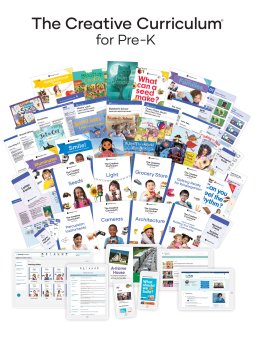
Loading navigation...
Criterion 2.1: Curriculum Approach and Design
Curriculum materials have a coherent and strategic design and approach.
Indicator 2.1a: Social and Emotional Development
Social and Emotional Development: Curriculum materials support social-emotional learning through a comprehensive approach that includes clear, developmentally-appropriate learning goals, a well-structured developmental sequence, and research-supported instructional practices.
The Creative Curriculum for Pre-K materials partially meet expectations for supporting social-emotional learning (2.1a).
Foundation Volume 3: Social-Emotional, Physical and Cognitive Development describes how and why an intentional focus on promoting children’s social–emotional development (as well as physical development and cognitive development) is an essential aspect of every day in an early childhood classroom. The first three chapters explain the three components of social–emotional development (positive relationships, emotional awareness and response, and social engagement) and how those components can be observed and nurtured in early childhood classrooms. In these chapters, teachers find guidance for supporting children's social and emotional development while they work and learn in the classroom’s interest areas and throughout different times of the day. The chapters also highlight relevant research on the importance of promoting social and emotional development in young children and the vital role that teachers and caregivers play in helping children grow as individuals and as positive, productive members of a community.
The materials provide clear, developmentally appropriate Social and Emotional learning goals and objectives for Development & Learning. Three out of 38 research-based objectives focus on Social-Emotional:
Objective 1. Regulates own emotions and behaviors
Manages Feelings
Follows limits and expectations
Takes care of own needs appropriately
Objective 2. Establishes and sustains positive relationships
Forms relationships with adults
Responds to emotional cues
Interacts with peers
Makes friends
Objective 3. Participates cooperatively and constructively in group situations
Balances needs and rights of self and others
Solves social problems
These objectives include detailed, color-coded teaching sequences that capture widely held expectations, indicators, and strategies for each objective. Some social and emotional instructional resources appear in Intentional Teaching Experiences (ITEs) such as:
Calm-Down Place (SE03), which introduces a classroom space where children can take a break when they are feeling upset.
Talk About Feelings (SEO6), which provides clear steps, materials, teacher language, and guidance aligned with goals such as sustaining relationships and identifying emotions.
My Turn at the Microphone (SE10), where children practice initiating and engaging in conversations.
Some social and emotional instructional resources appear in the Teaching Guides:
First Six Weeks- (pg.26) There is a focus question dedicated to feelings: “How can we express our feelings at school?” In the Reflection, teachers are prompted to model emotional language (“I’m feeling happy…”) and use “I statements,” with connection to review Intentional Teaching Experience SE16, “I Statements” (pg. 27).
Example from The First Six Weeks (SEL ITEs embedded in the daily flow): An At-a-Glance plan lists SEL ITEs directly in the daily resources (e.g., SE21 “Sunshine Message Board,” SE08 “Group Problem-Solving,” SE14 “Playing Together”) alongside Mighty Minutes and other resources (The First Six Weeks, p. 115).
Seeds Teaching Guide includes “Playful Observations.”
– Manages feelings (1a) includes guidance to support calming and emotional expression during real interactions (pg. 55).
– Suggests solutions to social problems (3b) prompts teachers to notice and support how children resolve peer issues and provides concrete ways to scaffold problem-solving (pg. 66).
Additional social and emotional resources are found in some of the Mighty Minute Activities (transition cards) that address Social and Emotional Objectives:
The Feelings In Your Face (MM143) aligned with Objective 2b, “Responds to emotional cues.”
Welcome, Everyone, (MM201) activity which promotes skills related to Objective 3a, “Balances the needs and rights of self and others.”
Sunshine & Rain Cloud (MM227 activity, which describes a short activity to promote skills related to Objective 2b, “Responds to emotional cues.”
The materials include research-based objectives and high-quality activities. SEL objectives are most often referenced within ITEs and supporting resources rather than systematically integrated into daily lesson plans. Additionally, the limited number of SEL-focused ITEs (36) and the flexible implementation structure require teachers to determine when and how these experiences occur. Although the Objectives for Development & Learning describe developmental progressions, the materials do not consistently show how those progressions are implemented across daily instruction. The color-coded Teaching Sequences describe scaffolding within individual activities rather than progression across lessons or the year. While the curriculum includes strong foundations for supporting social-emotional development, the materials do not consistently make the developmental sequence visible within the daily instructional framework. As a result, teachers must make individual decisions about when and how to address SEL, leading to inconsistent implementation across classrooms.
Overall, The Creative Curriculum for Pre-K provides a strong foundation for supporting social-emotional development through research-based objectives, guidance in the Foundation volumes, and instructional resources. However, SEL objectives and supports are not consistently embedded within the daily instructional framework in a clear way that demonstrates how skills build over time.
Indicator 2.1b: Language and Literacy
Language and Literacy: Curriculum materials support language and literacy instruction through a comprehensive approach that includes clear, developmentally-appropriate learning goals, a well-structured scope and sequence, and research-supported instructional practices.
The Creative Curriculum for Pre-K materials partially meet expectations for supporting language and literacy instruction (2.1b).
Foundation Volume 4, Language & Literacy, provides educators with instructional content on the components of language development and literacy learning, as well as research-based information on planning an effective literacy program that intentionally supports relevant objectives. Specific strategies and information are provided on the components of literacy, including:
vocabulary and language
phonological awareness
knowledge of print
letters and words
comprehension
books and other texts
literacy as a source of enjoyment
There are several objectives that address language and literacy. Objectives 8, 9, and 10 relate to children’s language development, and Objectives 15–19 relate to literacy learning. Objectives 37 and 38 relate to multilingual learners’ English language acquisition.
Objective 8. Listens to and understands increasingly complex language
Comprehends language
Follows directions
Objective 9. Uses language to express thoughts and needs
Uses an expanding expressive vocabulary
Speaks clearly
Uses conventional grammar
Tells about another time and place
Objective 10. Uses appropriate conversational and other communication skills
Engages in conversation
Uses social rules of language
Objective 15. Demonstrates phonological awareness, phonics skills, and word recognition
a. Notices and discriminates rhyme
b. Notices and discriminates alliteration
c. Notices and discriminates discrete units of sound
d. Applies phonics concepts and knowledge of word structure to decode text
Objective 16. Demonstrates knowledge of the alphabet
Identifies and names letters
Uses letter–sound correspondences
Objective 17. Demonstrates knowledge of print and the uses
Uses and appreciates books and other texts
Uses print concepts
Objective 18. Comprehends and responds to books and other texts
Interacts during reading experiences, book conversations, and text reflections
Uses emergent reading skills
Retells stories and recounts details from informational texts
Uses context clues to read and comprehend texts
Reads texts fluently
Objective 19. Demonstrates writing skills
Writes name
Writes conveying ideas and information
Writes using conventions
Objective 37. Demonstrates progress in listening to and understanding English
Objective 38. Demonstrates progress in speaking English
The materials offer some opportunities for children to explore language and literacy. Children engage with print, letters, rhymes, new vocabulary, and emergent writing through read-alouds, small groups, interest areas, and daily routines (Volume 3: Literacy, pp. 20–22, 30–35, 44–47, 72–75, 110–115). Intentional Teaching Experiences Cards, such as LL08, LL33, LL43, LL55, and LL61, show how teachers can connect literacy to science, storytelling, and creative play. Other resources, such as the Message Board and Dramatic Play Area, provide authentic opportunities to practice language in social and problem-solving contexts (Volume 2: Interest Areas, pp. 85, 92–100).
Additional resources supporting language and literacy instruction include:
Cameras Teaching Guide- Question of the Day targeting phonological awareness (“What is a word that rhymes with cat?”), plus alphabet knowledge (“What letter does your name start with?”) (Cameras Teaching Guide, p. 52). The same plan embeds literacy in Read-Aloud/Playing With Pre-Reading Skills using Mighty Minutes 234 “Perfect Pairs” (letter matching) and Mighty Minutes 266 “Letter Sounds” (letter–sound work) (Cameras Teaching Guide, p. 52) and includes Focused Language & Literacy via ITE LL17 “Walk a Letter” (Cameras Teaching Guide, p. 52).
Light Teaching Guide- embeds skill practice within a study context. One daily plan includes Focused Language & Literacy – “Identifies letter–sound correspondences (16b)”, using a “memory” activity with letter cards where children identify a letter and say its sound (Light Teaching Guide, p. 76).
Percussion Instruments Teaching Guide- includes Read-Aloud/Playing With Pre-Reading Skills – “Identifies letter–sound correspondences (16b)” using letter cards and repeated practice with a “letter-sound trains” routine (Percussion Instruments Teaching Guide, p. 88).
Teacher Guide Architecture Investigation 3, Day 4 (p. 81), the activity “playing with pre-reading skills” supports phonological awareness by having children sort items by initial sounds. While this aligns with Objective 15 (“demonstrates phonological awareness, phonics skills, and word recognition”), it is presented as an isolated experience rather than part of a structured progression.
Supporting resources, such as Volume 4: Language & Literacy and Objectives for Development and Learning, provide research-based components, teacher strategies, and developmental progressions (e.g., Objective 17, “demonstrates knowledge of print and its uses,” p. 96). However, these expectations are not consistently embedded into daily lessons. Some activities do not clearly identify which literacy skills they target (Volume 3: Literacy, pp. 44–46; Volume 2: Interest Areas, pp. 105–108), and lessons can be taught in varying order. The curriculum does not ensure a systematic sequence for developing skills such as phonological awareness, alphabet knowledge, and early writing (Volume 3: Literacy, pp. 64–70, 72–75, 110–115).
The materials include daily plans with read-alouds and literacy activities that target specific skills, but they are not organized into a clear developmental sequence aligned with literacy milestones. Other than the first Teaching Guide, which covers the first six weeks of school, and the final one, “Getting Ready for Kindergarten,” which covers the final six weeks, there is no single order for implementing the studies.
While the materials include developmentally appropriate literacy experiences and offer multiple opportunities for children to engage with language, print, and emergent writing through read-alouds, routines, and small-group activities, there is less clarity around how specific literacy skills are systematically introduced, reinforced, and developed across the year within the core instructional guidance. Developmental progressions are outlined in the Objectives for Development & Learning, though connections to their implementation within the Teaching Guides and daily lesson supports are not explicit. Additionally, the scope and sequence identify where objectives appear across studies but provide limited detail about the specific literacy content addressed or how skills are built across studies and over time.
Overall, The Creative Curriculum for Pre-K includes developmentally appropriate language and literacy goals, research-based guidance, and a variety of instructional resources. The materials do not provide a clearly articulated scope and sequence that organizes literacy learning in a systematic developmental order across the year. The color-coded Teaching Sequences describe scaffolding within individual activities rather than illustrating how literacy skills progress across lessons or over time.
Indicator 2.1c: Mathematics
Mathematics: Curriculum materials use a comprehensive approach that include clear, developmentally-appropriate learning goals, a well-structured scope and sequence, research-supported instructional practices and mathematical process standards to ensure effective and meaningful mathematical learning experiences.
The Creative Curriculum for Pre-K materials partially meet expectations for supporting mathematics instruction (2.1c).
Foundation Volume 5: Mathematics provides educators with content on the components of mathematics, guiding principles for effective instruction, and research-based strategies for fostering young children’s mathematical thinking. The volume addresses five key components of early mathematics learning, including:
Number and Operations
Geometry and Spatial Sense
Measurement
Patterns (algebra)
Data Analysis
This Foundation volume also discusses essential mathematical process skills, including problem-solving, reasoning, communicating, connecting, and representing. Particular emphasis is placed on strategies that support the integration of mathematics learning into daily routines and activities. Each set of daily plans, in the Teaching Guides, includes a time of day called Focused Mathematics. During this time, teachers are offered an idea for promoting children’s early mathematical thinking. There are four objectives and learning goals that address children’s mathematical learning. They are as follows:
Objective 20. Uses number concepts and operations
Counts
Quantifies
Connects numerals with their quantities
Understands and uses place value and base ten
Applies properties of mathematical operations and relationships
Applies number combinations and mental number strategies in mathematical operations
Objective 21. Explores and describes spatial relationships and shapes
Understands spatial relationships
Understands shapes
Objective 22. Compares and measures
Measures objects
Measures time and money
Represents and analyzes data
Objective 23. Demonstrates knowledge of patterns
Mathematics instruction includes:
Small-Group Discovery Time: Teachers facilitate focused, play-based activities targeting specific skills, supported by Intentional Teaching Experiences (ITEs).
Choice Time (Independent Discovery): Children engage in hands-on activities within interest areas that reinforce skills introduced during small-group sessions
The ITEs cards for mathematics outline objectives for each lesson and include some cross-curricular connections; however, clear learning goals are absent.
For example, three different cards that address the same objective, Objective 20: Uses number concepts and operations b. Quantifies but has varying learning goals that are not explicitly stated.
Card M01 Dinnertime- The activity has the teacher demonstrate and describe how to set a table using positional words (beside, above, on top), and it asks students questions that encourage counting, separating, and combining objects.
Card MO3 Seek & Find-The activity has the teacher describe a group she’s thinking about (ex, “I am thinking of animals that live in very cold places”), and students look in the basket to find something that belongs to that group. Once the items in that group are found, they count the objects.
Card M05 Sorting & Classifying-The activity has students sort objects by attributes (ie, big, small, color), and then students answer questions about each pile to determine which pile has more, is the smallest, and how objects are the same.
Other than the first Teaching Guide, which covers the first six weeks of school, and the final one, which covers the final six weeks (Getting Ready for Kindergarten), there is no designated order for implementing the studies. The studies can be taught in any order. The scope and sequence provided show the location of objectives across the studies, but it does not clearly outline the specific skills taught in each study or capture how the learning builds across them.
The materials provide daily opportunities for focused mathematics instruction through structured lessons and choice time; however, the organization of math content does not reflect a coherent sequence of skill development. For example, in the Percussion Instruments study, Investigation 2:
Day 1 focused Math lesson uses Mighty Minutes 160 labeled Objective 22 Compares & Measures c. Represents and analyzes data, children are asked to retell a story telling what happened first, second, third.
Day 2 focused Math lesson uses ITE M59 More of Fewer Towers labeled Objective 20 Uses Number Concepts & Operations b. Quantifies, the children are asked to build towers with cubes and play a game where they practice with more or fewer blocks.
Day 3 focused Math lesson uses ITE M83 Pendulum Power labeled Objective 22 Compares and Measures a. Measures objects, the teacher creates pendulums, and the children have access to objects (i.e., blocks, boxes, toilet paper tubes) to stack up and knock over with the pendulums. Children make predictions and experiment with building shorter and higher structures.
While the materials include daily opportunities for intentional mathematics learning, there is less clarity around how mathematics skills and concepts are developed across the year within the core instructional guidance. The materials are designed to be flexible in their order of use, though they do not outline a clear sequence for how mathematical content progresses over time. As a result, it is not evident when specific ideas are introduced, how concepts build across studies, or how instruction supports movement along established mathematics learning trajectories. Developmental progressions are described in the Objectives for Development & Learning, but connections to their implementation within the Teaching Guides and daily lesson supports are not explicitly shown to guide teachers in advancing children along these trajectories.
Overall, The Creative Curriculum for Pre-K provides some meaningful opportunities for mathematics learning through both structured and play-based experiences. However, the materials do not provide a clearly articulated scope and sequence that organizes mathematics learning in a systematic developmental order across the year. The color-coded Teaching Sequences describe scaffolding within individual activities rather than illustrating how mathematical concepts and skills progress across lessons or over time along math learning trajectories.
Indicator 2.1d: Science and Engineering
Science and Engineering: Curriculum materials support science and engineering learning experiences by offering clear, developmentally-appropriate learning goals that encompass core knowledge concepts, as well as research-supported instructional practices.
The Creative Curriculum for Pre-K materials partially meet expectations for supporting science and engineering learning experiences (2.1d).
Foundation Volume 6: Science and Technology, Social Studies & The Arts, Chapters 1-3 provide educators with comprehensive content on the components of science, guiding principles for effective instruction, and research-based strategies for fostering young children’s scientific understanding and thinking. The volume addresses three key components of science: physical science, life science, and Earth and the environment, as well as four components of technology standards: awareness of technology, basic operations and concepts, tools and equipment, and people and technology. The volume also includes information on incorporating science and technology into classroom interest areas and outdoor activities.
Five of the objectives address children’s learning in science and technology, but there is no clear evidence of learning goals for the Science and Technology objectives.
Objective 24: Uses scientific inquiry skills Objective 25: Demonstrates knowledge of the characteristics of living things Objective 26: Demonstrates knowledge of the physical properties of objects and materials Objective 27: Demonstrates knowledge of Earth’s environment Objective 28: Uses tools and other technology to perform tasks
Four of the six studies explicitly explore and investigate scientific concepts: percussion instruments (sound production), cameras, light, and seeds. There are no Intentional Teaching Experiences (ITEs) that explicitly focus on science and technology; however, some ITE cards have science and technology as related objectives. For example, Math ITE card M99 Living or Non-Living supports Objective 25: Demonstrates knowledge of the characteristics of living things by having children identify characteristics of living vs. non-living things and sort photos.
The materials provide opportunities for children to engage in inquiry-based investigations that address scientific concepts such as:
Percussion Instruments Study
-What percussion instruments are made of wood?
-What percussion instruments are made of metal?
-How can we make and play them?
-How do you play percussion instruments?
-What sounds do percussion instruments make?
Seeds Study
-What do seeds need to grow?
-How are seeds spread?
-How are seeds alike and different?
-What can we do with seeds?
In the Cameras study, instruction spans six weeks with intentionally embedded skills and guiding questions such as, “What does the picture look like when you take a photo of something that is moving?” Choice Time extends learning as children create short videos from photographs, reinforcing technological exploration and creative expression. Children also engage in engineering behaviors as they take apart cameras with small screwdrivers to examine internal components.
Similarly, the Architecture study uses a guided discovery approach during Focused Mathematics. On Day 2, students measure objects, predict circumference, compare predictions to actual measurements, and chart their results—activities that support analytical thinking, data interpretation, and early engineering design.
Additional science and engineering practices appear throughout weekly investigations. In the Cameras study, children listen to How Big Is a Pig? They participate in questioning and hypothesizing activities tied to environmental concepts such as ocean pollution. During math explorations, students use manipulatives to model patterns found in nature, such as counting beans or replicating arrangements with unit cubes. These tasks deepen observation, prediction, and reasoning skills.
Teachers support these experiences with intentional modeling, visual charts, and structured tools. For example, during outdoor learning in Large Group Round-Up, teachers reference the “Our Project Plan” chart to connect children’s free play with ongoing investigation, reinforce scientific thinking, and project continuity.
Science and Technology objectives are listed in the Year Ahead guide (scope & sequence) rather than within daily lesson plans, making it difficult to track progression or understand how concepts increase in complexity across studies. There is no content that addresses space science, and there are minimal engineering practices.
Overall, The Creative Curriculum for Pre-K materials offer children meaningful opportunities to engage in science learning through hands-on investigations, inquiry-based studies, and guided discovery experiences that support observation, questioning, and exploration. While these experiences incorporate elements of science and technology across multiple studies, the curriculum does not consistently articulate clear, explicit learning goals within daily lesson plans. The materials also do not document a coherent progression of science and engineering skills across studies.
Indicator 2.1e: Social Studies
Social Studies: Curriculum materials support social studies learning experiences by offering developmentally-appropriate learning goals that encompass core knowledge concepts, as well as research-supported instructional practices.
The Creative Curriculum for Pre-K materials partially meet expectations for supporting social studies learning experiences (2.1e).
Foundation Volume 6: Science and Technology, Social Studies & The Arts, Chapters 4-6 provide educators with comprehensive content on the components of social studies, guiding principles for effective instruction, and research-based strategies for fostering young children’s understanding and thinking related to social studies concepts. The volume addresses key components of social studies, such as the following:
people and how they live
people and the environment
people and the past
spaces and geography
Four of the objectives address children’s learning in social studies. A key finding is the absence of clearly defined learning goals for social studies and lesson plans tied to learning goals. They are as follows:
Objective 29: Demonstrates knowledge of self Objective 30: Shows basic understanding of people and how they live Objective 31: Explores change related to familiar people or places
Objective 32: Demonstrates simple geographic knowledge
Two of the six studies in The Creative Curriculum for Pre-K explicitly explore and investigate social studies concepts: grocery stores and architecture. There aren’t any Intentional Teaching Experiences (ITEs) that explicitly focus on social studies; however, some ITE cards have social studies listed as related objectives. For example:
ITE M36, “We’re Going on an Adventure,” relates to Objective 32, “Demonstrates simple geographic knowledge.” Questions to guide your observations include, “Was the child familiar with simple geographic features? Which ones? “
ITE M01, “Dinnertime,” which relates to Objective 30, “Shows basic understanding of people and how they live.” Children discuss the different foods they would serve at dinner
The materials emphasize four broad areas of learning: knowledge of self, understanding of people and how they live, changes related to familiar people or places, and basic geographic knowledge. While the Year Ahead guide outlines where some of these areas are addressed, it places greater emphasis on self-knowledge and on understanding people and their ways of life. Much of the content is embedded in literacy components, particularly through read-aloud texts such as All Kinds of Families, All Families Are Special, and Life with My Family. Other activities, such as taking a learning walk to meet school staff or examining digital maps during the Architecture study, also contribute to students’ exposure to social studies concepts.
Although activities that include social studies content are present, they are not consistently aligned with stated objectives. For example, in the Architecture Study (p. 51), during Choice Times, students construct buildings with no connections to social studies objectives.
Overall, The Creative Curriculum for Pre-K integrates social studies concepts into literacy experiences and play-based activities, providing children with informal opportunities to explore ideas about themselves, their families, communities, and familiar places. However, these experiences could be strengthened with more clearly defined, developmentally appropriate learning goals and lesson plans aligned to social studies objectives, along with a more clearly articulated progression.
Indicator 2.1f: Fine Arts
Fine Arts: Curriculum materials support fine arts experiences by offering developmentally-appropriate learning targets that encompass core knowledge concepts, as well as research-supported instructional practices.
The Creative Curriculum for Pre-K materials partially meet expectations for supporting fine arts experiences (2.1f).
Foundation Volume 6: Science and Technology, Social Studies & The Arts, Chapters 7-9, provides educators with comprehensive content on the components of the arts, including visual arts, music, dance, and dramatic play. Teachers are encouraged to establish specific interest areas in the classroom and outdoor activities for children to explore the arts.
Foundation Volume 2: Interest Areas includes Chapters 2, 4, and 8: Dramatic Play, Art, and Music & Movement. Each chapter describes how to design and set up the area, the material children learn, the teacher’s role, and sample letters to families that explain the learning taking place.
Four of the objectives address children’s learning in the arts.
Objective 33. Explores the visual arts Objective 34. Explores musical concepts and expressions Objective 35. Explores dance and movement concepts Objective 36. Explores drama through actions and language
There are no Intentional Teaching Experiences whose primary objective relates to the arts. Some have art-related objectives listed. For example:
ITE LL06, “Dramatic Retelling,” promotes skills related to Objective 36, “Explores drama through actions and language. “
ITE LL10, “Rhyming Chart,” is related to Objective 34, “Explores musical concepts and expression. “
Some of the teaching guides connect to the arts’ objectives, but the objectives are not specifically listed.
For example, in the Percussion Instruments Teaching Guide during Choice Time (pg. 15), it states,
“Invite the children to play along with the music from different genres using instruments from the classroom collection. Encourage them to notice how they play the instruments and pay close attention to the percussion instruments. “The drum and the triangle are both percussion instruments because they are played by hitting them. But you don't hit the triangle with your hand, you hit it with a stick or a mallet. What other instruments do we have that we can play that way?” This activity supports Objective 34: Explores musical concepts and expressions.
During Guided Discovery (p.35), it states.
“Display materials to create percussion instruments (e.g., cardboard tubes, tape, clean milk cartons, sand, small rocks). Offer instruments for the children to refer to for inspiration. Review the question of the day and ask How could we use the cardboard tube to make percussion instruments like the wooden ones that we're investigating? Support the children as they use various materials to make percussion instruments”. This supports Objective 33: Explores visual arts.
The Year Ahead guide indicates daily opportunities for fine arts across studies through activities involving music, art media, drama, and dance; however, clear learning goals and the ways the objectives are addressed within daily lesson plans are not consistently evident. Fine arts experiences are often delivered through free play or open-ended exploration, such as dramatic play with props, free access to musical instruments, or the use of art supplies for projects, but without clear guidance on expected learning outcomes or skill development.
Overall, The Creative Curriculum for Pre-K materials include fine arts content across multiple resources and learning experiences. The absence of explicitly defined fine arts learning goals, intentional instructional guidance, and clear identification of where arts objectives are addressed limits its effectiveness. Fine arts experiences do not reflect purposeful lesson planning aligned to Objectives 33–36. As a result, opportunities for intentional instruction, skill development, and a clear, thoughtful progression in the fine arts are not present across the materials.