
The Creative Curriculum® for Pre-K - Criterion 3.4
Loading navigation...
Criterion 3.4: Implementation Support
Curriculum materials include tools and resources for understanding, executing, and monitoring program implementation.
Indicator 3.4a
Curriculum materials are educative, developing teacher understanding of program design and providing guidance for implementation support.
The Creative Curriculum for Pre-K materials meet expectations for supporting teacher understanding and implementation (3.4a).
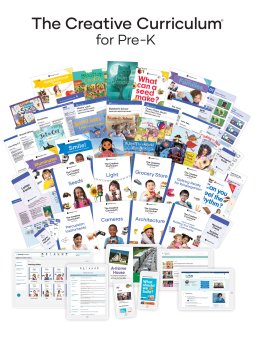
The materials provide a clear and robust explanation of its learning design and curriculum approach through a comprehensive, connected set of print and digital resources. The Curriculum Guide (pp. 24–25) explains the Studies approach, which uses a three-phase structure: Exploring the Topic, Investigating the Topic, and Celebrating Learning, to support project-based learning grounded in children’s curiosity, prior knowledge, and authentic problem-solving. This approach invites children to take the lead in asking questions, researching topics, solving problems, and sharing learning, while teachers support exploration through intentional activities and guided instruction. The Year Ahead: Scope and Sequence provides an overview of learning across the year. There are videos and QR codes that deepen teachers’ understanding of instructional materials.
The materials also include robust, domain-specific explanations and rationales for learning across all areas. The Foundation Volumes (Volumes 1–7) articulate the theoretical underpinnings of the materials, drawing on child development research, learning progressions, and domain-specific best practices. Each volume explains why the domain is important, how children learn within it, and how instructional strategies support whole-child development. Domains addressed include:
Volume 1: The Foundation
Volume 2: Interest Areas
Volume 3: Social-Emotional, Physical, and Cognitive Development
Volume 4: Language and Literacy
Volume 5: Mathematics
Volume 6: Science and Technology, Social Studies, and the Arts
Volume 7: Objectives for Development and Learning: Birth through Third Grade.
Clear expectations for implementation are established while also supporting flexibility and teacher decision-making. Daily lesson plans outline consistent instructional components, creating predictable expectations for implementation. At the same time, teachers are encouraged to adapt pacing, grouping, materials, and prompts based on children’s interests, observations, and developmental needs. The Instructional Teaching Experiences support flexible use by including guidance for multiple instructional settings, developmental adaptations, and individualized scaffolding sequences.
The materials consistently provide robust annotations, suggestions, and guidance to support teachers’ understanding and delivery of content. Teaching Guides include embedded callouts, sample teacher language, pacing notes, and reminders that clarify instructional intent. The materials reference teacher training and professional learning as important for successful implementation, particularly in areas such as assessment administration, the use of digital platforms, and the understanding of intentional teaching practices. Materials point teachers to online training, implementation guides, and optional professional learning modules, which signal that training is expected and valued.
However, expectations for teacher training are not clearly articulated as a coherent, required learning pathway. The materials do not consistently specify what training is required, when it should occur, or how it builds over time for new versus experienced teachers. Many supports are available on demand or as optional add-ons, and some deeper professional learning opportunities require additional purchase, limiting universal access.
Overall, The Creative Curriculum for Pre-K materials are educational and support developing teachers’ understanding of the program’s design and implementation. Through clearly articulated explanations of the Studies approach, comprehensive domain-specific Foundations volumes, and detailed guidance embedded in Teaching Guides and Intentional Teaching Experiences, the materials help teachers understand both why the materials are structured as they are and how to implement them effectively. Predictable lesson structures paired with flexible instructional guidance, robust annotations, and access to professional learning resources support implementation.
Indicator 3.4b
Curriculum materials provide guidance to support and evaluate implementation fidelity.
The Creative Curriculum for Pre-K materials partially meet expectations for providing guidance to support and evaluate fidelity (3.4b).
Through the Curriculum Guide, Teaching Guides, and Foundation Volumes, teachers are given explicit descriptions of the instructional model, including the three-phase Studies approach, expectations for daily practice, and the core features of high-quality instruction. Daily lesson plans embed guidance for eliciting prior knowledge, facilitating inquiry, scaffolding learning, and supporting child agency, helping teachers understand how fidelity should look in practice. These explanations are strengthened by connections to child development research and learning theory, which clarify why specific instructional practices matter.
While the materials clearly describe what effective practice looks like, they provide limited tools for formally evaluating implementation. Without detailed evaluation supports like checklists or rubrics, assessing implementation depends in part on teacher judgment. The materials include some support for reflection and instructional improvement, primarily through embedded observation prompts, planning guidance, and explanations within the Foundations Volumes. Teachers are encouraged to observe children closely, reflect on engagement and understanding, and adjust materials, scaffolds, or grouping as needed. The Foundations Volumes further promote reflective practice by explaining the rationale behind instructional decisions and encouraging teachers to consider how environments, routines, and interactions support learning. However, this guidance is largely indirect.
Overall, The Creative Curriculum for Pre-K provides clear guidance on what implementation looks like, including its instructional model, daily practices, and teaching strategies. Teachers are supported through some lesson guidance and explanations that help them understand and apply these practices. However, while expectations are defined, the materials offer limited formal tools for evaluating fidelity, relying instead on teacher reflection and interpretation, with only indirect support for monitoring and improvement.
Indicator 3.4c
Curriculum materials integrate technology to support student learning.
The Creative Curriculum for Pre-K integrates technology to support student learning. Technology is intentionally embedded across the curriculum to enhance instruction, extend learning experiences, and support communication between school and home. Rather than relying on child-facing apps or passive screen time, the program integrates technology as a meaningful instructional tool aligned with developmentally appropriate practice. Clear teacher guidance, high-quality digital media, and structured digital supports provide a robust framework that supplements hands-on, play-based learning without replacing it.
The materials provide a range of digital resources that enhance children’s learning experiences. Through the Digital Children’s Library, teachers and families gain access to more than 100 high-quality, developmentally appropriate books, including fiction, nonfiction, and fairytales. These texts can be used during classroom instruction or shared with families to extend learning at home, supporting early literacy in ways that would not be possible through print materials alone. Teachers also have access to videos, songs, and multimedia content housed in the online portal, which support science concepts, vocabulary building, movement activities, and social-emotional routines.
Technology integration is further strengthened by extensive teacher-facing guidance. In Foundation Volume 6: Science and Technology, Social Studies & the Arts, pages 14–73 provide a research-based rationale for including technology in high-quality early childhood programs. This section supports educators in understanding how and why technology fits into a developmentally appropriate classroom and offers practical guidance for applying technology throughout the curriculum, not just within isolated domains. Teachers receive explicit support in setting up and using the Technology/Computer Interest Area, selecting appropriate digital content, and ensuring technology use remains active, hands-on, and connected to children’s learning goals.
Overall, The Creative Curriculum for Pre-K materials integrate technology in a purposeful, developmentally aligned manner that enhances, not replaces, play-based learning. High-quality digital books, multimedia tools, documentation platforms, and strong teacher guidance collectively ensure that technology supports instruction, deepens learning experiences, and extends engagement into the home.